A lion escaped from the zoo and, spotting an elderly woman in the park, stopped right beside her; snipers already had him in their sights—but at that very moment, something unexpected happened
It started as an ordinary morning at the zoo. Nothing seemed out of place. I was making my usual rounds, checking enclosures and speaking with staff, when suddenly terrified screams erupted from the main walkway. People scattered in all directions—some grabbed their children, others hid in souvenir shops or climbed over barriers in panic.
I ran toward the noise and froze for a moment. Walking calmly—but quickly—down the path was a massive adult lion.

Later, we discovered that a power outage during the night had caused an electronic lock to fail, opening one of the enclosures. That’s how the lion named Atlas got out. The strangest part was that he wasn’t attacking anyone. He wasn’t frantic or hunting. It felt like he had a purpose. He moved forward with quiet determination, as if he knew exactly where he was going.
Atlas crossed the zoo grounds, broke through a service gate, and made his way into the streets. I immediately called the police and veterinarians equipped with tranquilizer darts, and we began the पीछ पीछ. Panic spread through the city—cars screeched to a halt, people shouted and ran—but the lion ignored it all. At times, he paused, inhaled deeply as if searching for a familiar scent, and then continued.
A few blocks later, he turned into a small park.
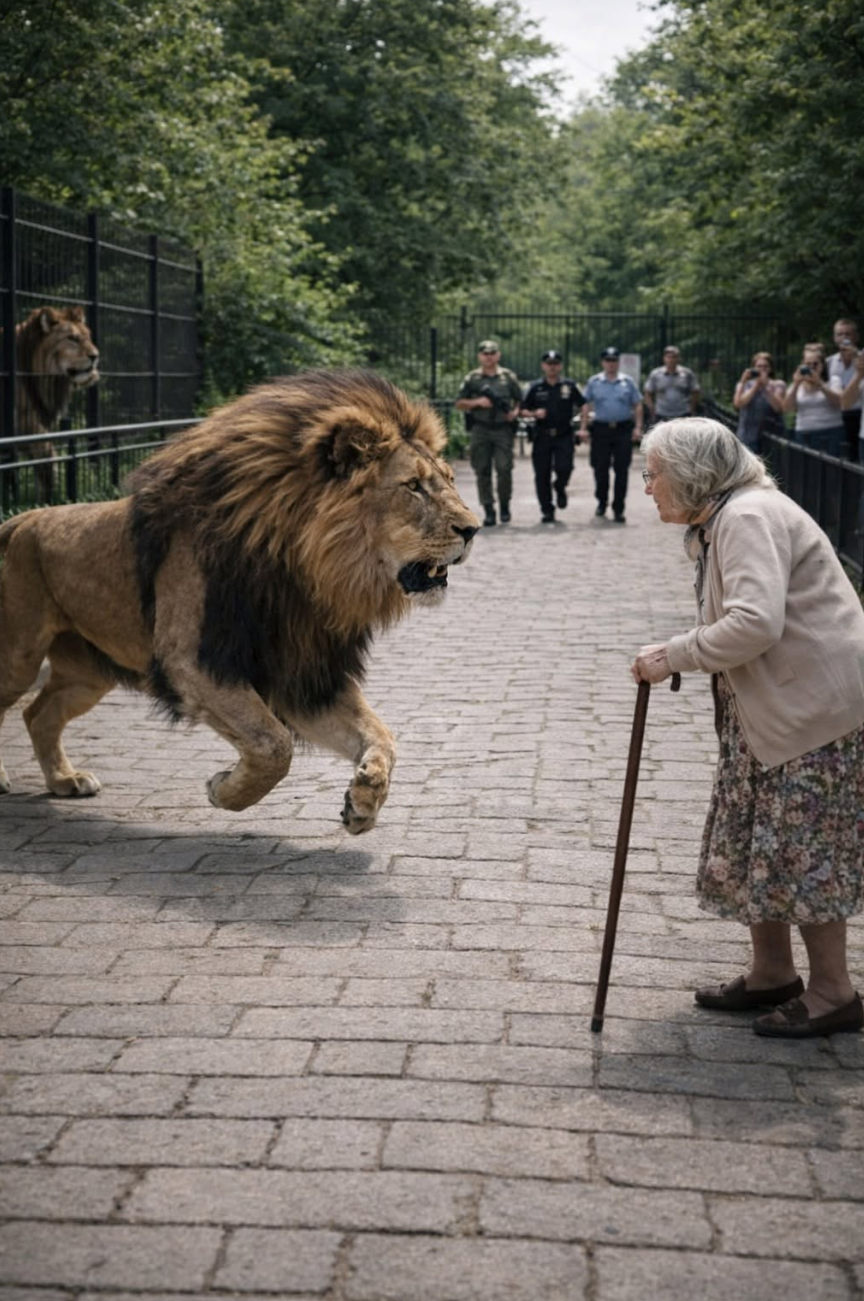
There, on a bench, sat an elderly woman calmly feeding pigeons with crumbs of bread. The enormous lion approached her slowly from behind. I wanted to shout a warning—but I knew that any sudden noise might provoke him.
The woman suddenly turned around.
Police officers had already raised their rifles. But in the next second, something happened that none of us expected.

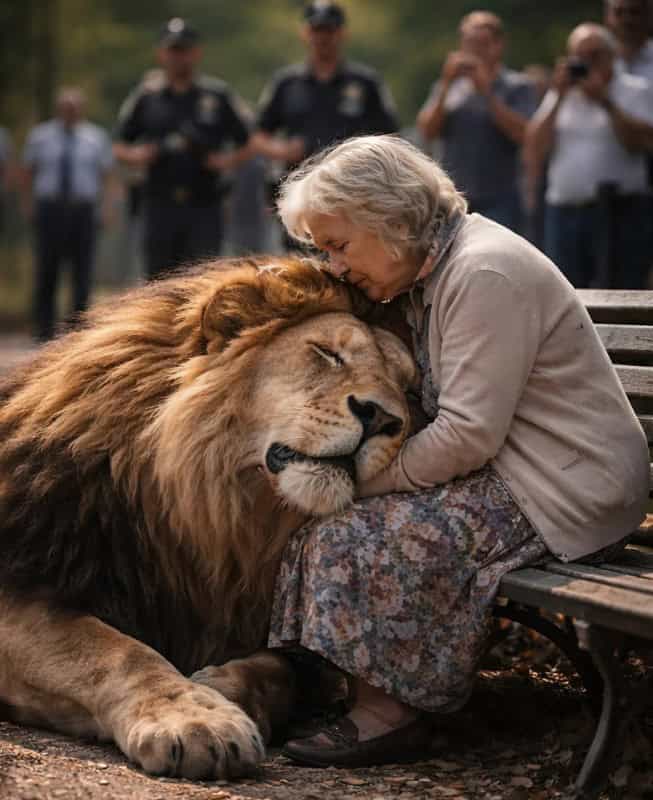
The lion stopped, looked at her—and then gently walked closer and lay down at her feet. He pressed his head against her knees and made a soft, rumbling sound… almost like a giant cat purring.
We approached cautiously and asked the woman to explain. Her name was Margaret—and her story left everyone speechless.
Twelve years earlier, she had been volunteering in Africa. One day, poachers killed a lioness, leaving behind a small cub with a broken leg and a severe infection. The veterinarians doubted he would survive.
Margaret took the cub in and nursed him back to life. She fed him from a bottle, treated his wounds, and stayed by his side through countless nights. He survived—but his leg healed poorly, leaving him with a slight limp for the rest of his life.
Returning him to the wild wasn’t possible. So Margaret arranged for him to be transferred to a zoo.
After that, she disappeared from his life.
Years later, after working abroad protecting elephants and rhinos, she returned and visited our zoo with her granddaughter. That’s when she saw him again. She recognized Atlas instantly—by the scar on his leg.
She didn’t approach him. She quietly left, afraid to disturb him.
But Atlas remembered.
He had caught her scent. And when the enclosure accidentally opened, he didn’t escape to hunt or attack—he escaped to find the woman who once saved his life.
After hearing the story, the zoo director was so moved that he gave Margaret a lifetime pass. She was allowed to visit every day and sit right by the glass of his enclosure.
From then on, their meetings became something visitors would never forget. Margaret would sit with a book, and Atlas would lie on the other side of the glass, pressing his body against it.
Sometimes she read to him. Sometimes she just spoke—like he was still that маленький cub she once held in her arms.
But time passed.
I began noticing that Margaret came less often. She walked slower each time. And one morning, her chair remained empty.
Atlas paced restlessly, letting out a low, drawn-out roar that sounded more like grief than anything else.
I went to visit her and learned the truth.
Margaret had passed away peacefully in her sleep.
When I returned to the zoo and sat in her usual spot, Atlas stared at me for a long time. There was something in his gaze—something impossible to describe—but it felt like he understood why she wasn’t coming back.
A week later, a lawyer arrived. He told us that after that day in the park, Margaret had changed her will. She ordered her house to be sold, and all the money donated to the zoo—to improve conditions for Atlas and the other big cats.
So the woman who once saved a helpless cub…
Found a way to take care of him one last time—even after she was gone.