The woman turned around. For one impossible second, I forgot how to breathe. “Mrs. Whitmore?” Eleanor Whitmore smiled. Not the polished smile I had seen on magazine covers or in newspaper photographs.
A real one. Warm. Almost nervous. “Hello, Clare.” I stood frozen in the doorway. Everyone in Columbus knew Eleanor Whitmore. Most people in Ohio probably did.
She had spent thirty-eight years building Whitmore Industries from a regional manufacturing company into a national corporation, but that was not why I knew her name.
Eight years earlier, after her husband died, Eleanor had established the Whitmore Foundation.
The foundation had funded shelters, workforce programs, domestic-violence organizations, legal clinics, and transitional housing programs across six states.
Two years earlier, Second Chapter House had applied for one of their grants.
We had not received it.
I had assumed Eleanor Whitmore had probably never even seen our application.
Now she was standing ten feet away from me.
“You know who I am,” she said.
“Of course I know who you are.”
“That makes this easier.”
I glanced behind me.
Sam had already closed the door.
I looked back at Eleanor.
“I’m sorry. I’m just confused.”
“I imagine you are.”
She gestured toward a chair.
“Would you sit with me?”
I sat.
My hands were trembling.
The narrow strip of blue fabric I had tied around my wrist suddenly felt ridiculous.
Eleanor noticed it immediately.
“What’s that?”
I instinctively covered it.
“Nothing.”
Her eyes stayed on my wrist.
“That doesn’t look like nothing.”
I hesitated.
Then I laughed.
It was the strange laugh people make when the truth is too humiliating to explain.
“It was supposed to be part of my dress.”
“Supposed to be?”
I looked down.
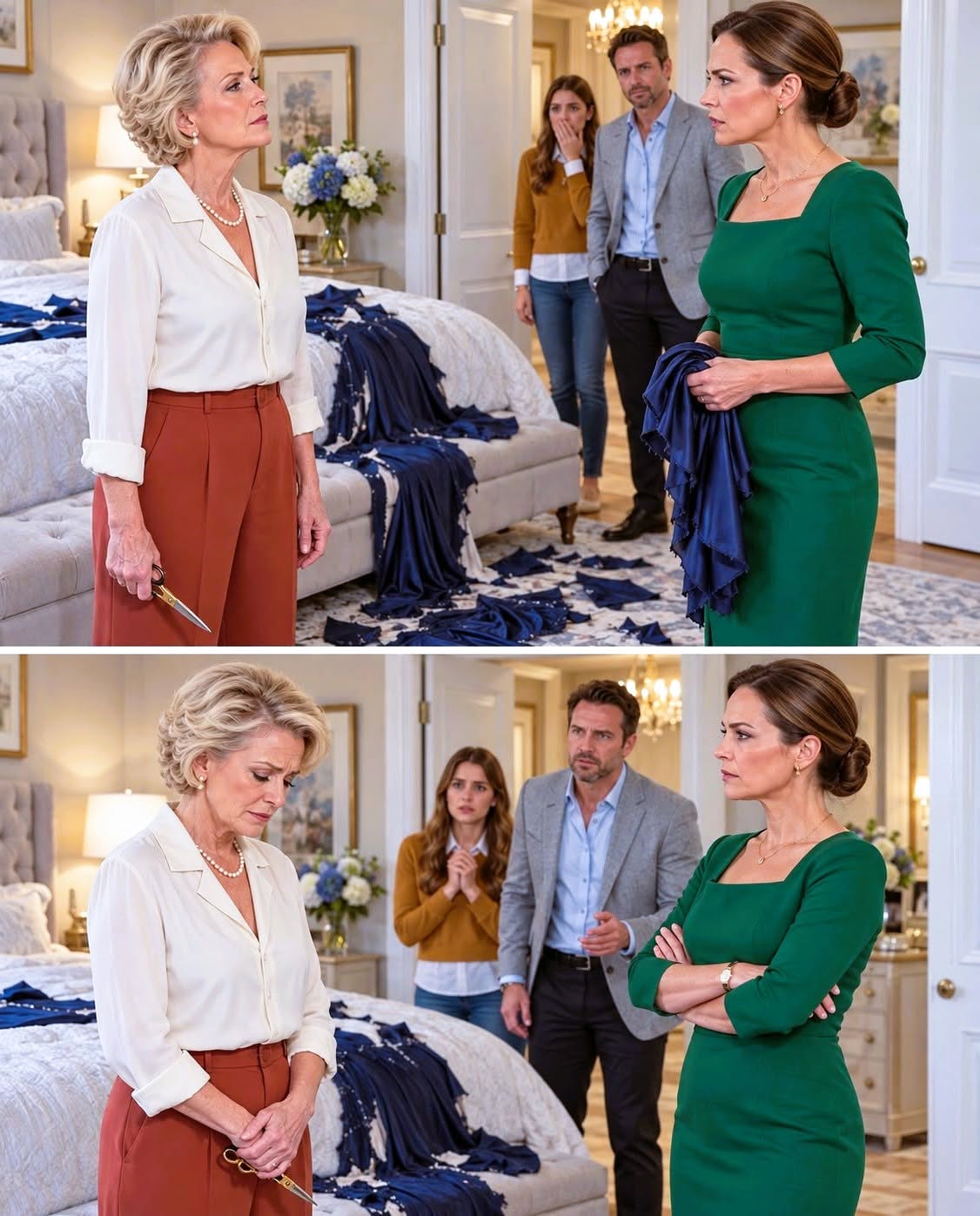
“My mother-in-law cut it apart last night.”
Eleanor’s expression changed.
“She did what?”
“She wanted me home tonight.”
“For what?”
“Dinner.”
Eleanor stared at me.
I almost smiled.
Hearing it spoken aloud made the entire situation sound even more absurd.
“She invited twelve people over,” I explained. “Apparently she decided ruining the gown would solve the scheduling conflict.”
“And your husband?”
The question landed differently.
I swallowed.
“He thought it was funny.”
Eleanor said nothing.
That silence lasted long enough that I began trying to rescue Mark from the judgment of a woman who had never met him.
A habit.
Even then.
Even there.
“He’s under a lot of pressure lately.”
Eleanor tilted her head.
“Clare.”
I stopped.
“You don’t have to explain someone else’s cruelty so that I’ll be comfortable hearing about it.”
Something inside my chest tightened.
I looked away.
She reached across the small table between us.
“May I?”
I realized she meant the strip of fabric.
I untied it and handed it to her.
Eleanor ran the midnight-blue material between her fingers.
“It was beautiful.”
“It was.”
“Was it expensive?”
“Fourteen hundred dollars.”
Her eyebrows lifted.
“And she destroyed it because she wanted you to serve dinner?”
“Yes.”
Eleanor folded the strip carefully.
Then she handed it back.
“Wear it.”
I blinked.
“What?”
“Tonight.”
She pointed toward my wrist.
“Wear it when you walk onto that stage.”
I stared at her.
“I’ll look ridiculous.”
“No.”
Her voice softened.
“You’ll look like someone who arrived anyway.”
That sentence nearly broke me.
I had spent the entire drive downtown telling myself not to cry.
Not tonight.
Not after everything.
But my eyes filled immediately.
Eleanor pretended not to notice.
Instead, she opened a leather folder on the table.
“There’s another reason I wanted to speak with you privately.”
She removed several sheets of paper.
My stomach tightened.
“What is that?”
“Something that should have happened two years ago.”
She slid the first page toward me.
At the top was the Whitmore Foundation letterhead.
Below it were the words:
SECOND CHAPTER HOUSE.
STRATEGIC EXPANSION GRANT.
My eyes moved toward the amount.
Then stopped.
I looked again.
“Is that…”
“Yes.”
I counted the zeros anyway.
“Five million dollars?”
“Five million over four years.”
I stared at her.
“That can’t be right.”
“It is.”
“But we applied two years ago and were rejected.”
“Yes.”
“Why?”
Eleanor leaned back.
“Because I never saw your application.”
I frowned.
“I don’t understand.”
“Neither did I.”
She opened another folder.
“Until three months ago.”
Something about her tone changed.
This was no longer ceremonial.
This was personal.
“One of our new program directors conducted an internal review of several applications that had been rejected under the previous regional committee.”
I waited.
“Your organization was one of them.”
“Why?”
“Because the notes attached to your application didn’t match the scoring.”
I felt cold.
“What notes?”
Eleanor turned a page toward me.
There were several paragraphs.
One sentence had been highlighted.
Applicant lacks stable executive leadership and may discontinue operations due to family obligations.
I read it twice.
“That isn’t true.”
“I know.”
“We’ve never missed a quarter.”
“I know.”
“Our retention numbers were among the highest in the state.”
“I know.”
“Who wrote this?”
Eleanor didn’t answer immediately.
That frightened me more than an immediate answer would have.
“Technically,” she said, “the comment was submitted through an outside community reference.”
My heart began beating harder.
“Who?”
“Someone contacted our regional review committee claiming to know you personally.”
I stared at her.
“And?”
“They said your organization depended almost entirely on your personal involvement, that your marriage was under strain because of your work, and that you were considering stepping away.”
My mouth went dry.
“I never said that.”
“I know.”
“Who told them?”
Eleanor watched me carefully.
“Your husband.”
The room disappeared.
Not literally.
But that was how it felt.
The walls remained.
The mirror remained.
The lights remained.
Yet everything seemed to move several feet farther away.
“Mark?”
“Yes.”
“No.”
I shook my head.
“No, Mark wouldn’t—”
Then I stopped.
Because the worst part was that I could already imagine his explanation.
He would say he had been concerned.
He would say he had been protecting me.
He would say five million dollars would have created too much pressure.
He would say our marriage needed me.
Our home needed me.
His mother needed me.
Everyone needed me.
Except apparently the women I had built Second Chapter House to serve.
Eleanor continued quietly.
“He called twice.”
I closed my eyes.
Twice.
Not an impulsive comment.
Not a misunderstanding.
Twice.
“He specifically asked the committee not to disclose that he had contacted them.”
“Why would they listen to him?”
“They shouldn’t have.”
Her voice hardened.
“That failure belongs to us.”
I opened my eyes.
“Did his call cost us the grant?”
“I can’t say that with absolute certainty. There were multiple factors in the committee’s decision. But his statements were included in the negative assessment, and they should never have been treated as verified facts.”
I stared at the papers.
Five million dollars.
I thought about every fundraising dinner.
Every emergency appeal.
Every time I had sat at my kitchen table at midnight moving numbers around because a woman and her children needed three more nights in a motel.
Every employee whose raise I postponed.
Every apartment we could not afford.
Every waiting list.
Every woman we turned away because all eighteen beds were full.
Mark knew.
He knew all of it.
And while I was begging strangers to believe in my work, my own husband had quietly told people not to.
“Why are you telling me this tonight?”
“Because you deserve to know.”
Eleanor paused.
“And because I’m presenting your award.”
I looked at her.
“You?”
“Yes.”
“But why?”
A smile touched her face.
“Because I asked.”
“Why?”
She studied me.
“Do you remember a woman named Denise Parker?”
I almost laughed.
“Of course.”
“She’s here tonight.”
“I know.”
“She contacted me six months ago.”
I blinked.
“What?”
“She sent me a letter.”
Eleanor reached inside the folder again.
“She told me that fourteen years ago she walked into a church basement believing her life was over.”
My throat tightened.
“She told me a woman named Clare Bennett sat with her for three hours, helped her open her first checking account, helped her rewrite a résumé, found her a lawyer, and then called her every Tuesday for six months because she was afraid Denise would give up.”
I looked down.
“She exaggerated.”
“She included the phone records.”
Despite everything, I laughed.
That sounded exactly like Denise.
Eleanor smiled.
“She also told me she now employs twenty-seven people.”
“Thirty-one.”
“Thirty-one,” Eleanor corrected.
“She said that too.”
Eleanor leaned forward.
“She told me that when people talk about Second Chapter House, they use statistics. Three thousand women served. Hundreds placed in employment. Families housed. Legal cases referred. But Denise said those numbers miss the point.”
I swallowed.
“What did she say the point was?”
Eleanor’s eyes softened.
“She said you taught women who had spent their lives making themselves smaller that taking up space was not a moral failure.”
I could not answer.
Because that was precisely what I had failed to teach myself.
A knock sounded at the door.
Sam opened it slightly.
“Five minutes.”
Eleanor stood.
“So.”
She held out her hand.
“Are you ready?”
I looked at the black dress Denise had loaned me.
Then at the strip of ruined blue fabric.
I tied it around my wrist again.
This time tightly.
“Yes.”
Eleanor smiled.
“Good.”
Then she added:
“Because there’s one more surprise.”
I stared at her.
“I’m beginning to dislike that word.”
She laughed.
“This one is better.”
Back at my house, Patricia’s dinner had collapsed by 6:10.
I learned the details later.
Melissa told me everything.
Apparently Patricia had genuinely believed I would return.
Even after watching me leave.
Even after I had said plainly that I was not cooking.
She assumed I was “making a point.”
So she did nothing.
At 5:45, eleven guests were sitting in my living room drinking wine.
At 6:00, someone asked when dinner would be ready.
At 6:05, Patricia opened the refrigerator.
Raw beef.
Unwashed vegetables.
Unbaked cheesecake.
Nothing prepared.
Mark apparently stood in the kitchen staring at everything as though dinner might assemble itself if he waited long enough.
“What exactly did she say?” he asked.
Patricia slammed the refrigerator shut.
“She’s having one of her episodes.”
I had never had an episode.
Unless having boundaries counted.
One of Patricia’s friends suggested ordering pizza.
Patricia refused.
“This was supposed to be a proper dinner.”
“Then cook it,” Melissa said.
Apparently the kitchen went silent.
Melissa was thirty-one.
Mark’s daughter from his first marriage.
She had been nine when Mark and I married.
Her biological mother lived in Arizona and had been mostly absent during Melissa’s childhood, which meant I had attended school conferences, bought prom shoes, helped with college applications, sat in the emergency room when she broke her wrist, and slept on her couch for three nights after her first serious breakup.
She had called me Mom exactly once.
She was nineteen.
Drunk.
Crying.
She never said it again.
I never asked her to.
Patricia looked at her.
“Excuse me?”
“You’re the one who invited everyone.”
“I expected Clare to handle it.”
“Clare has an award ceremony.”
Patricia rolled her eyes.
“For that women’s club?”
Melissa stared at her.
“It’s a national humanitarian award.”
“It’s all the same thing.”
Mark opened a bottle of wine.
“Can we not turn this into a drama?”
Melissa looked at him.
“You mean like Grandma cutting Clare’s dress apart?”
Mark froze.
“How do you know about that?”
“Clare sent me a picture.”
I had.
At 2:13 that afternoon.
I had not even known why.
Maybe some part of me wanted one person in that family to say it was wrong.
Melissa had replied with four words.
She did WHAT to it?
Then she called three times.
I did not answer because I was already driving to the theater.
According to Melissa, she walked into the kitchen and saw the pieces of my gown still sitting inside a grocery bag beside the trash.
Patricia had apparently planned to throw them away.
Melissa pulled them out.
“You actually did it.”
Patricia sighed.
“Oh, stop.”
“You cut her dress.”
“It was fabric.”
“It was hers.”
“She was being selfish.”
Melissa looked at her father.
“And you let this happen?”
Mark poured his wine.
“She’s fifty-two years old, Melissa. She doesn’t need you defending her.”
“No.”
Melissa nodded.
“She apparently needed her husband defending her.”
That was when Mark’s face changed.
“Watch your mouth.”
“Why?”
“Because I’m your father.”
“And Clare is your wife.”
Nobody spoke.
Then someone in the living room called:
“Mark? The ceremony is starting!”
The award program was being broadcast locally and streamed nationally through the foundation’s media partner.
Patricia had no intention of watching.
She later admitted that.
But one of her guests, Nancy, knew about my award.
“Turn it on,” Nancy called.
Patricia resisted.
Melissa took the remote.
And at 6:42 p.m., eleven dinner guests, Patricia, Mark, and Melissa gathered around my television.
They arrived just in time.
Backstage, I heard my name.
Not spoken yet.
Just the introduction.
“For fourteen years, our next honoree has dedicated herself to women rebuilding their lives after divorce, displacement, financial abuse, unemployment, and family crisis…”
I closed my eyes.
My hands were freezing.
Eleanor stood beside me.
“You’re shaking.”
“I know.”
“Good.”
I looked at her.
“Good?”
“It means it matters.”
The audience applauded as the video package began.
Photographs appeared on the enormous screen.
The church basement.
Our first office.
Denise standing beside me holding a paint roller.
Our first transitional apartment.
Our staff.
Graduation ceremonies.
Women holding job certificates.
Children playing in our courtyard.
Then came a photograph I had forgotten existed.
Mark had taken it.
Fourteen years earlier.
I was sitting cross-legged on the basement floor surrounded by folders and donated office supplies.
I looked exhausted.
Young.
Terrified.
Happy.
For a moment, seeing that woman hurt.
Because she believed Mark was proud of her.
Maybe he had been.
Maybe people can love the beginning of your dream and resent what happens when it grows larger than the space they intended to give you.
The video ended.
The stage darkened.
Then the announcer said:
“To present the National Beacon Award for Community Leadership, please welcome business leader, philanthropist, and chair of the Whitmore Foundation, Eleanor Whitmore.”
The applause exploded.
Eleanor squeezed my hand once.
Then walked onto the stage.
At home, Patricia dropped her wineglass.
It did not break.
It landed on the rug.
Red wine spread across the cream fibers.
Nobody moved to clean it.
Because Patricia knew Eleanor.
Not personally.
But she knew exactly who she was.
Everyone did.
Mark apparently sat forward.
“What the hell?”
Melissa smiled slowly.
“Oh, this should be interesting.”
Patricia looked at her.
“Why?”
Melissa pointed toward the television.
“Watch.”
Eleanor reached the podium.
“Fourteen years ago, a woman rented two rooms in a church basement.”
Her voice carried easily through the theater.
“She had very little money, very little institutional support, and absolutely no guarantee that anyone would come.”
A photograph of the original Second Chapter House appeared behind her.
“She bought six folding chairs.”
I smiled.
I had forgotten the chairs.
“They were twenty-two dollars each,” Eleanor continued.
The audience laughed.
“She told me that herself because apparently she remembers every dollar she spent that year.”
More laughter.
I covered my face.
Then Eleanor’s voice changed.
“The first week, one woman came.”
Denise appeared on the screen.
I heard someone in the audience gasp.
“The second week, three came.”
More photographs.
“Within a year, more than one hundred.”
Applause began.
“Today, more than three thousand women have walked through the doors of Second Chapter House.”
The applause grew.
“But numbers alone do not explain why we are honoring Clare Bennett tonight.”
Eleanor turned toward the wings.
Toward me.
“We are honoring her because she understood something before many institutions did.”
She paused.
“That unpaid work is still work.”
My throat tightened.
“That managing a household is management.”
Applause.
“That surviving financial control requires financial courage.”
More applause.
“That rebuilding at forty, fifty, or sixty is not failure.”
People began standing.
“And that a woman does not become less valuable simply because someone else has grown accustomed to her sacrifices.”
That sentence hit me directly in the chest.
Back at home, I was told Patricia stopped breathing for a moment.
Mark stopped smiling.
Eleanor continued.
“Tonight, the Whitmore Foundation is proud not only to honor Clare Bennett with the National Beacon Award.”
My eyes widened.
She had not told me what came next.
“We are also announcing a five-million-dollar strategic partnership with Second Chapter House.”
The theater erupted.
I actually stumbled backward.
Sam caught my elbow.
“What?”
He grinned.
“You heard her.”
Five million dollars.
It had been real on paper.
But hearing it announced to a thousand people made my knees weak.
Eleanor continued.
“This funding will establish three new transitional housing centers, expand legal and employment services, and create the Clare Bennett Rebuilding Fund.”
I shook my head violently from backstage.
No.
Absolutely not.
She glanced toward me and smiled.
Too late.
The audience laughed when they saw my reaction on the side screen.
“And,” Eleanor said, “because Clare has spent fourteen years helping other women understand that their work deserves recognition, we thought tonight might be an appropriate evening to remind her that hers does too.”
Then she said my name.
“Clare Bennett, please come out here.”
I walked onto the stage.
I do not remember the first ten steps.
I remember the light.
I remember the sound.
I remember Eleanor waiting.
And I remember seeing Denise in the front row.
She was standing.
Crying.
Clapping harder than anyone.
Then I noticed something else.
Hundreds of women were standing.
Some I recognized.
Some I did not.
Former clients.
Volunteers.
Employees.
Board members.
Donors.
Women I had met once fourteen years earlier.
Women whose children were now adults.
Women who had once walked into my office unable to look me in the eye.
They were standing for me.
I covered my mouth.
Eleanor hugged me.
Then she whispered:
“Don’t make yourself small now.”
I nodded.
She placed the award in my hands.
It was heavier than I expected.
Glass and silver.
Beautiful.
I approached the microphone.
And for several seconds, I could not speak.
The audience waited.
Then I looked at the blue strip tied around my wrist.
Something changed.
“My dress was supposed to be blue.”
The audience laughed softly.
I smiled.
“It had sleeves yesterday.”
More laughter.
Eleanor lowered her head, smiling.
I continued.
“I had a different speech prepared.”
I looked at the award.
“It was about gratitude.”
Pause.
“And I am grateful.”
I looked toward my staff.
“My staff deserves more gratitude than I could fit into one speech.”
Applause.
“Our volunteers deserve it.”
More applause.
“Our donors.”
I looked at Denise.
“And especially the women who trusted us with their lives when they had every reason not to trust anyone.”
My voice cracked.
Denise pressed her fingers to her lips.
“But something happened yesterday that changed what I wanted to say tonight.”
The room became quiet.
I did not mention Patricia.
I did not mention Mark.
That mattered to me.
I did not want the most important moment of my career to become another story about them.
So instead I said:
“For a long time, I confused being needed with being valued.”
Silence.
“I thought love meant being the person who stayed late, cleaned up, remembered everything, fixed everything, forgave everything, and asked for almost nothing.”
I swallowed.
“And I became very good at it.”
Someone in the audience murmured.
I continued.
“Many of the women who come through our doors are good at it too.”
I looked directly into the camera.
“They know everyone’s birthday.”
A few people laughed.
“They know which child needs medicine, which bill is due, where the spare key is, how much money is left until payday, and exactly how to make twelve dollars stretch until Friday.”
My voice strengthened.
“They are experts at keeping other people’s lives functioning.”
Applause began.
“But sometimes nobody asks them what their own life is supposed to become.”
The room went quiet again.
“So tonight, I want to say something I probably needed to hear twenty-three years ago.”
I took a breath.
“Being useful is not the same thing as being loved.”
Nobody moved.
“And sacrifice stops being generous when other people begin treating it as your obligation.”
The applause started slowly.
Then grew.
I looked down at the blue ribbon around my wrist.
“If somebody has spent years teaching you that your dreams are inconvenient, their inconvenience is not proof that your dreams are wrong.”
People stood.
I did not expect that.
My hands shook.
I held the award tighter.
“And sometimes the bravest thing you can do is leave dinner uncooked.”
Laughter broke through the applause.
I laughed too.
Then I finished.
“To every woman beginning her second chapter…”
I looked at Denise.
“…please remember that you are allowed to be a person in your own story.”
The entire theater stood.
At home, nobody spoke for almost thirty seconds.
The camera followed me as I walked offstage beside Eleanor Whitmore.
Then the broadcast cut to commercial.
Patricia reached for the remote.
Melissa took it first.
“Don’t.”
Patricia glared at her.
“Give me that.”
“No.”
“This ridiculous spectacle has gone far enough.”
Nancy stared at Patricia.
“Ridiculous?”
Patricia looked around.
That was when she realized something had changed.
Her friends were no longer looking at the television.
They were looking at her.
One of them knew about the dress.
Melissa had told them during the broadcast.
“What?” Patricia snapped.
Nancy stood.
“I think I’m going home.”
“So am I,” another woman said.
Patricia stared.
“Dinner hasn’t even—”
“There is no dinner,” Melissa said.
Nobody laughed.
Within ten minutes, every guest had left.
Patricia stood in my living room beside an untouched stack of plates.
Mark was still sitting on the sofa.
His face had gone pale.
Because he understood something Patricia did not.
The grant.
He knew what it meant.
Five million dollars.
Whitmore Foundation.
The application he had sabotaged.
Melissa noticed.
“Dad?”
He looked at her.
“What?”
“You look sick.”
“I’m fine.”
Then his phone rang.
Unknown number.
He ignored it.
It rang again.
Then mine would later show seventeen missed calls from him.
I answered none.
After the ceremony, there was a reception.
I should have been celebrating.
Instead, I stood alone for several minutes in a service hallway behind the ballroom.
The award was in my hands.
Five million dollars had just been announced.
People were waiting to congratulate me.
And all I could think was:
Mark called them twice.
Denise found me.
“You disappeared.”
“I needed air.”
She looked at my face.
“What happened?”
I handed her the papers Eleanor had given me.
She read them.
Her expression changed.
“No.”
“Yes.”
“Mark?”
I nodded.
She kept reading.
Then she looked up.
“I’m going to kill him.”
Despite myself, I laughed.
“You’re five foot three.”
“I’ll use a chair.”
That made me laugh harder.
Then I started crying.
Not elegant tears.
Not award-ceremony tears.
Ugly, exhausted sobs.
Denise dropped the papers and wrapped both arms around me.
“He knew,” I whispered.
“I know.”
“He watched me panic about money.”
“I know.”
“He watched me cry when we had to turn families away.”
“I know.”
“He knew.”
Denise held me tighter.
And then another voice came from the hallway.
“I knew something too.”
I pulled away.
Melissa stood there.
My stomach dropped.
“What are you doing here?”
She had apparently driven downtown the moment the broadcast ended.
Her eyes were red.
“I need to tell you something.”
Denise looked at me.
I nodded.
Melissa stepped closer.
“I heard Dad talking to Grandma three years ago.”
My entire body became still.
“About what?”
“About you.”
She wiped her face.
“I was in the kitchen. They were in the dining room.”
“What did they say?”
Melissa looked ashamed.
“Grandma said your organization was getting too big.”
I said nothing.
“She said you were becoming impossible to manage.”
Manage.
The word made me feel physically ill.
“And your father?”
“He said he was handling it.”
I stared at her.
“Handling it how?”
“I didn’t know.”
She looked at the papers on the floor.
“Now I think I do.”
Denise bent down and picked them up.
Melissa continued.
“I should have told you.”
“You didn’t know what they meant.”
“I knew enough.”
“No.”
“You always defended me.”
Her voice broke.
“Even when I treated you like you were just Dad’s wife.”
I stepped toward her.
“Melissa.”
“When Mom missed my college graduation, you were there.”
I swallowed.
“When Dad forgot my twenty-fifth birthday dinner, you drove two hours because I called you crying.”
“You were my daughter.”
She covered her mouth.
I realized what I had said.
Were.
Past tense.
Her face crumpled.
“No.”
I immediately reached for her.
“No, sweetheart. That’s not what I meant.”
She grabbed me.
“You’re still my mom.”
And there it was.
The word she had not used in twelve years.
Mom.
I closed my eyes.
For one moment, I allowed myself to hold something that was not broken.
I did not go home that night.
That was the first decision.
Not divorce.
Not revenge.
Not confrontation.
Just:
I am not going home tonight.
I stayed with Denise.
At 11:43 p.m., Mark texted:
We need to talk.
At 11:51:
You embarrassed me tonight.
At 12:06:
Mom is devastated.
At 12:22:
People are calling.
At 12:40:
You made us look terrible.
At 1:03:
Call me.
At 1:17:
This has gone too far.
Not once:
Congratulations.
Not once:
I’m proud of you.
Not once:
I’m sorry about your dress.
Not once:
I need to explain what I did to your grant.
I stared at the messages.
Then I turned my phone off.
And slept for nine hours.
When I woke, Denise was making pancakes.
“You snore.”
“I do not.”
“You absolutely do.”
“I have slept beside someone for twenty-three years and nobody has ever told me that.”
Denise flipped a pancake.
“Maybe he was too busy sabotaging nonprofit grants.”
I stared at her.
She winced.
“Too soon?”
I laughed.
“A little.”
Then the doorbell rang.
Denise looked toward the hallway.
“Expecting anyone?”
“No.”
She opened the door.
Mark stood outside.
My husband looked as though he had not slept.
“Where is she?”
Denise crossed her arms.
“Good morning to you too.”
“Clare.”
I appeared behind her.
Mark looked at me.
His shoulders dropped with relief.
“Thank God.”
I felt nothing.
That frightened me.
Not anger.
Not love.
Nothing.
“We need to talk.”
I nodded.
“Talk.”
“Privately.”
“No.”
His eyes moved toward Denise.
“This is our marriage.”
I looked at him.
“You involved the Whitmore Foundation in our marriage.”
His face changed.
There it was.
Confirmation.
Not surprise.
Not confusion.
Recognition.
Denise whispered:
“Oh, you absolute bastard.”
Mark stepped inside.
“I can explain.”
“Then explain.”
“It wasn’t what you think.”
“Did you contact them?”
Silence.
“Mark.”
“Yes.”
The word was barely audible.
“Twice?”
He looked away.
“Yes.”
“Why?”
“Because you were disappearing.”
I stared at him.
“What?”
“You were never home.”
“I worked.”
“Exactly.”
His voice rose.
“Every year it got bigger. More employees. More meetings. More travel. More speeches. You stopped needing me.”
The sentence hung between us.
I almost could not believe it.
“That’s why?”
“No.”
He rubbed his face.
“That’s not what I mean.”
“It sounds exactly like what you mean.”
“I was losing my wife.”
“So you tried to damage my organization?”
“I was trying to save our marriage.”
Denise actually laughed.
Mark glared at her.
“Stay out of this.”
She pointed toward her front door.
“You are standing in my house.”
He turned back to me.
“I thought if the expansion slowed down, things would go back to normal.”
Normal.
I finally understood.
Normal meant me being smaller.
Normal meant dinner waiting.
Normal meant his mother’s needs coming first.
Normal meant Second Chapter House staying a charming little project that made me feel fulfilled but never powerful.
Never independent.
Never important enough to inconvenience him.
“You didn’t want your wife back.”
I spoke quietly.
“You wanted your employee back.”
His face hardened.
“That’s ridiculous.”
“Is it?”
“I supported you for years.”
“You supported me while you thought I would fail.”
“That is not fair.”
“And when I didn’t fail?”
He had no answer.
“When it became real, you tried to stop it.”
“I was scared.”
Finally.
A true sentence.
I nodded.
“So was I.”
He looked at me hopefully.
“But I never destroyed you because I was scared.”
The hope disappeared.
Then he said the one thing that ended whatever remained.
“What about my mother?”
I stared at him.
“What about her?”
“She’s seventy-four.”
“And?”
“She can’t just be abandoned.”
“By whom?”
“You know what I mean.”
“No, Mark.”
I stepped closer.
“I want you to say it.”
He stared at me.
“You expect me to handle her alone?”
And suddenly I smiled.
Not because it was funny.
Because there it was.
Twenty-three years compressed into one sentence.
You expect me to handle her alone?
His mother.
His responsibility.
His expectation.
My labor.
I walked into Denise’s kitchen, opened my purse, and removed my wedding ring.
Mark followed me.
“Clare.”
I placed it on the table.
His face drained.
“Don’t.”
“I’m not filing anything today.”
Relief flickered across his face.
“Thank God.”
“I’m meeting a lawyer Monday.”
The relief vanished.
“Clare.”
“I want copies of every financial record in the house.”
“You’re serious?”
“Yes.”
“Over a dress?”
I looked at him.
“No.”
I pushed the Whitmore Foundation papers toward him.
“Over fourteen years.”
Three weeks later, we discovered the second betrayal.
Mark had not merely contacted the foundation.
He had also quietly withdrawn $86,000 from our joint home-equity line over four years.
Some had gone toward Patricia’s expenses.
Some toward credit cards I did not know existed.
Twenty-two thousand dollars had gone into an investment account controlled by Mark.
And nearly eleven thousand had been spent covering Patricia’s gambling losses.
When my attorney asked Mark about it, he called it “family money.”
My attorney asked:
“Which family?”
That question apparently ended the meeting.
Patricia called me forty-six times during the first month.
I answered once.
Only once.
She did not apologize.
She began with:
“Do you have any idea what you’re doing to my son?”
I almost admired the consistency.
“You cut my dress apart.”
“Oh, for heaven’s sake.”
“That sentence tells me everything I need to know.”
“It was a dress.”
“No, Patricia.”
I looked at the blue strip still sitting on my desk.
“It was permission.”
She went quiet.
“You thought you had permission to destroy something I loved because you wanted something from me.”
“That is dramatic.”
“You raised a son who thought he had permission to damage my work because he wanted something from me.”
Silence.
“And both of you were shocked when I finally said no.”
Her voice became icy.
“You’ll regret breaking up your family.”
I thought about Melissa.
About Denise.
About three thousand women.
About the staff who had hugged me until I could barely breathe when the grant became official.
Then I said:
“I’m finally finding out who my family is.”
And I hung up.
The divorce took eleven months.
It was ugly.
Then quiet.
Then ugly again.
Mark fought hardest over the house.
I surprised everyone by letting him have it.
My attorney thought I was making an emotional decision.
Maybe I was.
But I did not want the staircase.
I did not want the bedroom.
I did not want the dining room where I had served Patricia’s Christmas dinners.
I did not want the kitchen where Mark had stood while I cooked meals for people who barely noticed when I sat down.
I wanted a smaller house.
So I bought one.
Two bedrooms.
A porch.
A ridiculous yellow front door.
The first night I slept there, I ate cereal for dinner.
Standing at the counter.
At 8:15, Melissa arrived carrying Chinese food.
At 8:22, Denise arrived with wine.
At 8:40, Eleanor Whitmore appeared with a housewarming gift.
I stared at her.
“How did you get my address?”
She looked at Denise.
I looked at Denise.
Denise shrugged.
“I can be bought.”
“With what?”
“Cheesecake.”
Eleanor handed me a small box.
Inside was a pair of sewing scissors.
For one second, I just stared.
Then I laughed so hard I cried.
“I thought you deserved new ones,” she said.
I hugged her.
One year after the award ceremony, Second Chapter House opened its second residential center.
We named it Parker House.
Denise objected.
Loudly.
I ignored her.
Six months later, the third center opened.
The following spring, we broke ground on the fourth.
At the ceremony, I noticed a woman standing near the back of the crowd.
Patricia.
I had not seen her in almost two years.
She looked smaller.
Older.
She waited until almost everyone had left.
Then approached me.
“I saw your interview.”
I nodded.
She looked toward the new building.
“So this is what five million dollars buys.”
“No.”
I looked around.
“This is what people build with it.”
She nodded slowly.
Then her eyes fell to my wrist.
I still sometimes wore a small bracelet made from the surviving fabric of the blue gown.
Denise had secretly taken several pieces to a seamstress.
The woman created twelve bracelets.
One for me.
One for Denise.
One for Melissa.
The others went to women from the first year of Second Chapter House.
Patricia recognized the fabric immediately.
Her face changed.
“You kept it.”
“Yes.”
She looked ashamed.
For the first time.
Actually ashamed.
“I shouldn’t have done that.”
I said nothing.
“I was angry.”
Still nothing.
“I thought…”
She stopped.
“What?”
She looked at me.
“I thought if you became too important outside that house, you wouldn’t need us anymore.”
There it was again.
Need.
I nodded.
“And were you right?”
Patricia looked at the building behind me.
“No.”
I waited.
She corrected herself.
“Yes.”
I raised an eyebrow.
“You don’t need us.”
“No.”
Her eyes filled.
“But I suppose that isn’t the same as saying you never loved us.”
That surprised me.
“No,” I said.
“It isn’t.”
She looked down.
“Mark isn’t doing well.”
I felt a small ache.
Not enough to go back.
But enough to remember that twenty-three years had existed.
“I’m sorry to hear that.”
“He misses you.”
I nodded.
“I miss parts of him too.”
She looked hopeful.
I stopped that hope before it grew.
“Missing someone isn’t always an instruction.”
Patricia stared at me.
Then nodded.
“I suppose not.”
She turned to leave.
“Patricia.”
She stopped.
I had imagined that moment many times.
In some versions, I humiliated her.
In others, I told her exactly what I thought of her.
But standing there beside a building that would soon house forty women and their children, revenge felt strangely small.
So I said:
“I hope you learn to cook the pot roast.”
She stared at me.
Then, unexpectedly, laughed.
A real laugh.
So did I.
Then she walked away.
Three years after the night she destroyed my gown, I stood backstage at the same theater.
But this time, I was not receiving an award.
I was presenting one.
The recipient was a sixty-one-year-old woman named Lorraine Ellis.
She had spent thirty-five years raising four children and caring for her husband’s parents.
At fifty-eight, her husband left.
She arrived at Second Chapter House with $214 and no résumé.
Three years later, she owned a bookkeeping company employing eleven women.
Lorraine was backstage shaking so badly that she could barely hold her notes.
“I can’t do this.”
“Yes, you can.”
“No.”
She looked toward the stage.
“There are eight hundred people out there.”
“I know.”
“What if I embarrass myself?”
“You probably will.”
She stared at me.
I smiled.
“So what?”
She laughed nervously.
Then she noticed my bracelet.
“That’s pretty.”
I looked down.
Midnight blue.
Three years old.
Frayed around the edges.
“It used to be a dress.”
She frowned.
“That sounds like a story.”
“It is.”
“What happened?”
The announcer began introducing Lorraine.
I could hear applause.
I touched the bracelet.
“Someone thought destroying the dress would keep me home.”
Lorraine stared.
“Did it?”
I smiled.
“No.”
The stage manager signaled.
Ten seconds.
Lorraine inhaled.
“I’m terrified.”
“I know.”
Five seconds.
I squeezed her hand.
Then I repeated the words Eleanor Whitmore had once given me.
“Don’t make yourself small now.”
Lorraine walked onto the stage.
The audience rose.
I stood behind the curtain watching her.
My phone buzzed.
A message from Melissa.
Turn on the livestream comments later. Everyone loves Lorraine.
Then another message.
Proud of you, Mom.
I read that one twice.
Mom.
It still mattered every time.
I slipped my phone back into my purse.
Onstage, Lorraine began speaking.
Her voice shook for the first sentence.
Less on the second.
By the third, she had found herself.
I smiled.
People sometimes ask me whether I still have the award.
I do.
It sits on a shelf in my office.
But the strange thing is that I rarely look at it.
The bracelet matters more.
Because the award represents what other people finally saw in me.
The bracelet represents what I finally saw in myself.
There is a difference.
For twenty-three years, I believed strength meant carrying everything without complaint.
Now I know better.
Sometimes strength is putting something down.
Sometimes strength is walking out the door.
Sometimes it is letting twelve hungry adults figure out their own dinner.
Sometimes it is sitting in a Walgreens parking lot with both hands wrapped around a steering wheel while every frightened part of you begs you to turn around—and driving forward anyway.
That was the real moment my life changed.
Not when Eleanor Whitmore announced five million dollars.
Not when the audience stood.
Not when Mark saw me on television.
Not even when I removed my wedding ring.
It changed in that parking lot.
Because nobody rescued me there.
Nobody applauded.
Nobody knew what I was deciding.
I simply chose, for once, not to abandon myself.
And perhaps that is why I kept one last piece of the gown.
It hangs inside a frame in my office.
Underneath it is a small brass plaque.
People constantly ask what it means.
The plaque contains only five words:
SHE WENT TO THE CEREMONY ANYWAY.
And whenever a frightened woman sits across from my desk telling me she is too old to begin again, too scared to leave, too embarrassed to try, or too accustomed to being invisible to imagine another life, I point toward that little strip of midnight-blue fabric.
Then I tell her the truth I learned much later than I should have.
There will always be someone who benefits from you believing you are small.
Someone who prefers you quiet.
Someone who likes you best when you are available, accommodating, grateful, exhausted, and easy to control.
They may even call that love.
But love does not require your disappearance.
And the people who genuinely love you will not need you to destroy yourself to prove that you belong to them.
Outside my office window, I can see the courtyard of Parker House.
A little girl is chasing bubbles across the grass.
Her mother is sitting beneath a tree with a laptop open, taking one of our accounting courses.
Another woman is leaving for a job interview.
Someone inside is laughing.
The sound reaches my window.
Fourteen years ago, Second Chapter House consisted of two basement rooms and six folding chairs.
Today, we have four centers.
Forty-three employees.
Hundreds of volunteers.
Thousands of women whose stories continued after they thought they had reached the end.
Mine did too.
Sometimes I think about that Friday night.
The bedroom.
The scissors.
The pieces of blue fabric scattered across the carpet.
Patricia standing beside my ruined gown.
Mark smiling.
“You’re a wife, not some celebrity. Remember that.”
I remember exactly how small I felt.
And sometimes I wish I could walk back into that room and stand beside the woman I was.
I would not tell her about the award.
I would not tell her about the grant.
I would not tell her about the television cameras, the standing ovation, the new centers, the divorce settlement, the yellow front door, or the thousands of women whose lives would eventually intersect with hers.
I would tell her something much simpler.
Pick up the pieces.
Not because you are going to repair the dress.
You are not.
Some things are not meant to be repaired.
Pick them up because tomorrow you are going to wear one around your wrist.
Then you are going to walk out the front door.
They will be angry.
Let them.
They will call you selfish.
Let them.
They will say you have changed.
Let them be right.
Drive to the theater.
Do not turn around.
Because tomorrow night, while they are sitting in the house waiting for you to come back and serve them dinner, they are going to switch on the television.
And for the first time, they are going to see the woman they spent years refusing to see.
More importantly—
so are you.
And that will change everything.
💬THE END! THANK YOU FOR READING! ❤️🙏