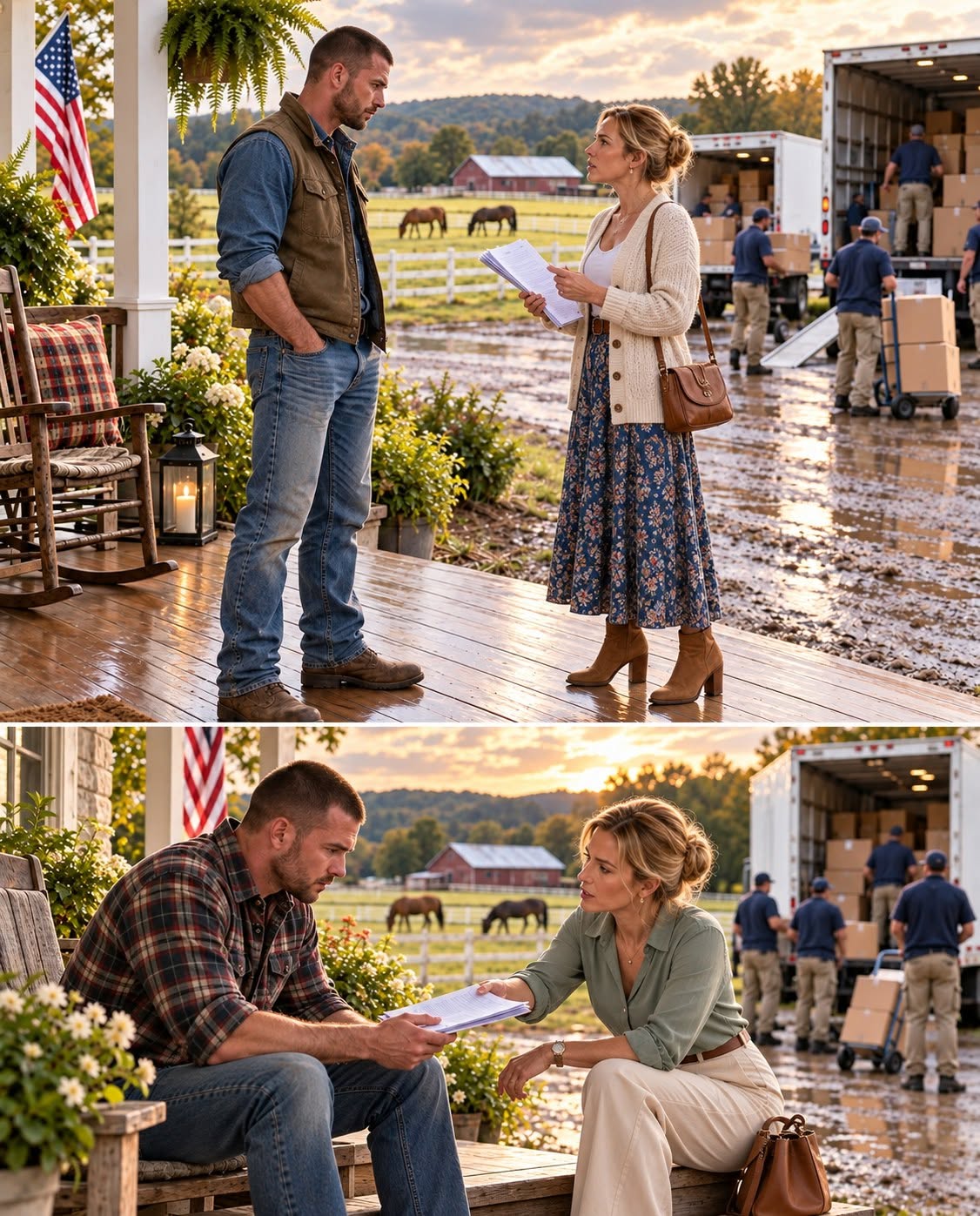
Clare thought the ranch was already hers. She thought the moving trucks proved it. She thought the court stamp proved it. She thought the relatives’ letters proved it.
Most of all, she thought the recording of my voice had finally given her what she needed. “Sometimes I think it would be easier to sell everything and walk away.”
She played it again.
Right there on my porch.
In front of the movers.
In front of her fiancé.
In front of the home our parents had spent forty years building.
My own exhausted voice came through the tiny speaker.
Clare smiled.
“Well?” she asked. “Anything else you want to say?”
I looked at her phone.
Then at the trucks.
Then down the long driveway.
And I smiled.
“Actually,” I said, “yes.”
Her expression changed slightly.
I stepped off the porch.
“Tell your movers not to unpack.”
Clare laughed.
“They’re not unpacking, Jacob.”
“I know.”
I looked directly at her.
“They’re leaving.”
Her fiancé, Eric, stepped forward.
He had spent the last several months behaving as though marrying my sister had somehow made him part owner of my parents’ land.
“Enough,” he said. “You’ve dragged this out long enough.”
I ignored him.
Instead, I looked toward the front gate.
A dark SUV had just turned onto the driveway.
Behind it was a county vehicle.
Clare followed my eyes.
Her smile disappeared.
The SUV stopped twenty yards from the house.
The driver’s door opened.
A woman stepped out.
She was in her late fifties, wearing a gray coat and carrying a leather document case.
I had met her only twice before.
But my father had known her for twenty-three years.
Her name was Rebecca Lawson.
She had prepared my parents’ estate plan.
And unlike Clare’s attorney, Rebecca hadn’t arrived to argue about what my father wanted.
She had arrived carrying proof.
Clare stared at her.
“Who is that?”
I put my hands in my jacket pockets.
“You wanted paperwork.”
Rebecca started walking toward us.
“I thought I’d bring someone who has it.”
The county vehicle parked behind her.
A deputy stepped out.
That finally made the movers stop.
One of them looked at Clare.
“Ma’am?”
Clare snapped, “Keep working.”
The mover didn’t move.
Rebecca reached the porch.
“Jacob.”
“Rebecca.”
She looked at Clare.
Then Eric.
Then the trucks.
Her face remained completely calm.
“Which one of you authorized entry onto the property?”
Clare lifted her chin.
“I did.”
“On what authority?”
“I’m the legal owner.”
Rebecca opened her document case.
“No,” she said.
One word.
Nothing dramatic.
But Clare’s face tightened.
“My attorney has already filed—”
“Your attorney filed a petition.”
Rebecca pulled out several documents.
“A petition is not a judgment.”
Clare’s cheeks flushed.
“He said—”
“I don’t particularly care what he told you.”
Rebecca turned toward the movers.
“For your own protection, gentlemen, nobody should remove personal property from this residence.”
One mover immediately stepped backward.
Clare stared at him.
“I hired you.”
“And she’s got a deputy,” he said.
I almost laughed.
Clare spun toward me.
“You called the police?”
“No.”
Rebecca answered for me.
“I contacted the sheriff’s office after receiving notice that an unauthorized attempt might be made to take possession of disputed property.”
Clare pointed at the documents in her own hand.
“It isn’t unauthorized!”
Rebecca studied her.
“Then you won’t mind if we compare documents.”
For the first time that afternoon, Clare looked uncertain.
Only for a second.
Then the arrogance returned.
“Fine.”
She handed over her folder.
Rebecca read silently.
Page after page.
The rain continued falling.
Nobody spoke.
Finally Rebecca looked up.
“This doesn’t transfer ownership.”
Clare’s voice sharpened.
“It proves Jacob manipulated our parents.”
“No. It alleges that.”
“My father wasn’t competent when he signed the final will.”
Rebecca’s expression changed.
Not much.
But enough.
“Be very careful with that statement.”
Clare folded her arms.
“Why?”
“Because I was there.”
Silence.
Clare blinked.
Rebecca continued.
“I supervised the execution of both your parents’ estate documents.”
“That doesn’t prove anything.”
“No.”
Rebecca reached into her case.
“This does.”
She removed a thick envelope.
It was yellowed slightly around the edges.
Across the front, in my father’s handwriting, were four words.
FOR MY CHILDREN — TOGETHER.
My throat tightened.
I had never seen it before.
Clare had.
I knew immediately.
Her entire face changed.
Rebecca noticed too.
“So,” she said quietly, “you recognize this.”
Clare said nothing.
I looked between them.
“What is it?”
Rebecca didn’t answer immediately.
Instead, she looked at Clare.
“Would you like to tell your brother?”
Clare’s lips parted.
Nothing came out.
“Tell me what?”
Still nothing.
I stepped closer.
“Clare.”
She looked away.
That was when I knew.
Whatever was inside that envelope, my sister had known about it before I did.
Rebecca handed it to me.
My fingers trembled slightly as I opened it.
Inside was a letter.
Three pages.
Dad’s handwriting.
I recognized it immediately.
The heavy block letters.
The way his capital J leaned too far to the right.
The little ink smudges where his hand dragged across the page.
At the top was a date.
Eleven months before he died.
I started reading.
Jacob and Clare,
If you are reading this, your mother and I are probably no longer here to explain our decisions ourselves.
I stopped.
For a second, the porch disappeared.
I could see Dad at the kitchen table.
Coffee beside him.
Reading glasses halfway down his nose.
Mom complaining that he pressed too hard when he wrote.
I swallowed.
Then I continued.
The ranch is going to Jacob.
This is not because we love him more.
It is not because Clare is less our daughter.
It is because equal love does not always require identical gifts.
Clare received help for law school, her first apartment, and the down payment on her condominium.
Jacob remained here.
He worked beside us.
He gave up opportunities we know he never told us about.
He cared for the animals when I could no longer lift feed bags.
He drove your mother to treatment.
He repaired roofs, fences, pumps, tractors and everything else I was too proud to admit I could no longer handle.
The ranch is not a prize.
It is work.
Jacob has already paid for much of it in years.
My vision blurred.
I lowered the letter.
Clare’s face had gone pale.
“You knew about this?”
She didn’t answer.
“Clare.”
“I knew Dad wrote something.”
“That isn’t what I asked.”
Eric stepped between us slightly.
“Maybe everyone should calm down.”
I turned toward him.
“You should stay out of this.”
He gave me a hard look.
But he stepped back.
I kept reading.
Clare, if you feel hurt by this decision, I understand.
But do not punish your brother for a choice your mother and I made.
You chose a different life.
We were proud of you for choosing it.
Jacob chose this one.
We were proud of him too.
There is one more thing.
If either of you tries to force the sale of the ranch against Jacob’s wishes, Rebecca has instructions regarding the conservation agreement.
I stopped again.
“The what?”
Rebecca nodded.
“The conservation agreement.”
Clare whispered something.
I barely heard her.
“What?”
She looked at Rebecca.
“You said that wasn’t finalized.”
Rebecca’s eyes narrowed.
“I never said that.”
“You told me—”
“You contacted my office three weeks after your father’s funeral pretending to need a copy for estate-tax purposes.”
My head snapped toward Clare.
She stared at the floor.
Rebecca continued.
“My assistant refused to provide confidential supporting documents because you were not the executor.”
I felt something cold move through me.
“You called her office?”
Clare finally looked at me.
“It was our parents’ estate.”
“No.”
My voice was quiet.
“It was information you weren’t entitled to.”
She threw up her hands.
“Oh, please, Jacob. Stop acting like I broke into Fort Knox.”
Rebecca took another document from the case.
“This agreement matters because your parents placed restrictions on certain forms of development and commercial subdivision.”
Eric suddenly stepped forward.
“What restrictions?”
Rebecca looked at him.
And there it was.
Fear.
Not on Clare’s face.
On Eric’s.
It lasted maybe half a second.
But I saw it.
Rebecca saw it too.
“What exactly were you planning to do with the property, Mr. Dawson?”
“Nothing.”
“Interesting.”
Rebecca looked through another folder.
“Because someone representing Dawson Development Partners requested zoning maps for this parcel six weeks ago.”
My eyes moved to Eric.
Clare turned slowly toward him.
“You said that was preliminary.”
He looked furious.
“Not now.”
Rebecca raised an eyebrow.
“Dawson Development?”
I asked.
Eric said nothing.
I looked at Clare.
“What were you planning?”
She folded her arms.
“Don’t be dramatic.”
“What were you planning?”
“It was an opportunity.”
“For what?”
Silence.
Then Rebecca answered.
“Based on the documents my office obtained yesterday, a residential development.”
I stared at my sister.
She stared back.
“How many houses?”
She didn’t answer.
Rebecca did.
“Current concept documents show forty-two.”
For several seconds, all I could hear was rain.
Forty-two houses.
I looked across the pasture.
Dad’s pasture.
The place where he taught me to ride.
The hill where Mom used to sit with a thermos during spring mornings.
The creek where Clare and I had caught frogs when we were children.
Forty-two houses.
Roads.
Driveways.
Garages.
Streetlights.
I looked at Clare.
“You were going to destroy it.”
“Oh, stop.”
“Forty-two houses?”
“You’re acting like this place is sacred ground.”
“To me, it is.”
“Well, sentiment doesn’t pay bills!”
Her voice echoed across the porch.
The movers looked away.
Clare took a breath.
Then she said the thing I think she had wanted to say for years.
“You got everything.”
I stared at her.
She pointed toward the house.
“The house. The land. The barns. The equipment. Everything.”
“You got your inheritance.”
“Money.”
“Yes.”
“Not this.”
“No. Not this.”
Her eyes filled with tears, but her voice remained angry.
“You know what everyone said after the funeral?”
I didn’t answer.
“They said, ‘At least Jacob has the ranch.’”
She laughed bitterly.
“Nobody said, ‘At least Clare has anything.’ They acted like you were the child who mattered.”
“That isn’t true.”
“It is to me.”
And for one moment, I saw my sister instead of my opponent.
The girl who used to race me barefoot across the yard.
The girl who left for college with Dad’s old suitcase because she refused to let him buy her a new one.
The girl who called home every Sunday.
Somewhere along the way, grief had become arithmetic.
Who got more.
Who sacrificed more.
Who was loved more.
But then I looked at the moving trucks.
The fake tenant notices.
The photographs.
The recording.
The legal threats.
Grief could explain pain.
It could not excuse what she had done with it.
“You could have told me that,” I said.
Her jaw tightened.
“Would it have changed anything?”
“Maybe.”
“Would you have given me half the ranch?”
“No.”
She laughed.
“There.”
“But I would have listened.”
“I didn’t want you to listen.”
Her voice dropped.
“I wanted you to lose.”
That hurt more than I expected.
Rebecca closed her folder.
“Well, that admission certainly simplifies the emotional part.”
Clare glared at her.
“This isn’t over.”
“No,” Rebecca said. “It isn’t.”
Then she looked at me.
“There’s another document.”
I frowned.
“What document?”
Rebecca reached into the case again.
This time she pulled out a sealed plastic sleeve.
Inside was a notarized affidavit.
Dad’s signature was at the bottom.
My stomach tightened.
“What is that?”
“Your father anticipated a challenge.”
Clare looked confused.
Rebecca continued.
“Apparently, this family has a history of inheritance disputes.”
I remembered stories.
Dad’s brother fighting over Grandpa’s equipment.
A cousin contesting farmland.
Arguments that lasted decades.
Dad hated all of it.
Rebecca handed me the affidavit.
Dad had written that he was making his estate decisions knowingly and voluntarily.
He named Clare.
He named me.
He explained exactly why the ranch was going to me.
And then came the sentence that ended the argument Clare had built her entire case around.
My decision is not the result of pressure, manipulation, incapacity, or mistake.
I read it twice.
Then a third time.
Clare shook her head.
“That proves nothing.”
Rebecca looked at her.
“There are two witnesses.”
“Friends of Jacob’s?”
“No.”
“Employees?”
“No.”
“Who?”
“Your father’s physician and the retired probate judge who lived three properties east.”
Clare went silent.
Rebecca continued.
“There is also a recorded statement.”
My head lifted.
“A recording?”
“Yes.”
Clare looked genuinely shocked now.
“What recording?”
Rebecca’s voice became softer.
“Your father wanted there to be no ambiguity.”
She opened her tablet.
“I don’t think we need to play it here.”
“Yes.”
My voice came out before I had time to think.
Everyone looked at me.
I swallowed.
“Play it.”
Rebecca hesitated.
Then she tapped the screen.
My father appeared.
Alive.
Sitting in his study.
Wearing the blue plaid shirt Mom hated because one sleeve had a bleach stain.
My knees almost gave out.
He looked thinner than I remembered.
Older.
But his eyes were clear.
He looked directly into the camera.
“My name is Thomas Warren.”
My breath caught.
Dad.
“I am making this statement regarding my estate because Rebecca tells me my children may someday need to hear the decision directly from me.”
He smiled slightly.
“Knowing those two, she’s probably right.”
I laughed.
I couldn’t help it.
A broken little sound escaped me.
Clare looked away.
Dad continued.
“I love both my children.”
His expression became serious.
“Clare, if you are watching this, I need you to understand something.”
My sister froze.
“The ranch going to Jacob is not a judgment against you.”
Her eyes filled.
“You built a life away from here because that is what you wanted. I was proud of you every step of the way.”
Clare covered her mouth.
Dad leaned toward the camera.
“But Jacob stayed.”
He paused.
“He stayed when staying cost him something.”
I closed my eyes.
There were things I had never told Clare.
The agricultural program I had been accepted into three states away.
The job offer I turned down.
The woman I nearly married who eventually told me she couldn’t spend her life waiting for me to stop choosing the ranch.
Dad knew.
Apparently he had always known.
“He never asked us to pay him back,” Dad said.
“So this is me paying him back.”
Then Dad looked down.
When he looked up again, his eyes were wet.
“And Clare…”
She was crying now.
“If you ever feel tempted to fight your brother over this place, remember the summer you were nine.”
Clare made a tiny sound.
I remembered too.
The barn fire.
Lightning.
Smoke.
Dad carrying animals out.
Mom screaming for us to stay near the house.
Clare had disappeared.
I found her inside the smaller barn trying to free her pony.
I dragged her out seconds before part of the roof collapsed.
Dad’s voice continued.
“You two used to protect each other.”
Clare was openly sobbing.
“I hope money never makes you forget how.”
The video ended.
Nobody moved.
Even Eric looked uncomfortable.
For a few seconds, I thought that might be it.
I thought maybe Dad had reached her.
Then Clare wiped her face.
Her expression hardened.
“Emotional manipulation.”
I stared at her.
Rebecca stared at her.
Even Eric looked surprised.
Clare pointed toward the tablet.
“That’s what this is. Dad knew exactly what he was doing.”
I felt something inside me finally break.
Not rage.
Hope.
The hope that somewhere beneath everything, Clare would become my sister again if I found the right words.
She wasn’t ready.
Maybe she never would be.
I folded Dad’s letter.
“Leave.”
Clare laughed through her tears.
“You think a video settles ownership?”
“No.”
I looked toward the deputy.
“The law can settle ownership.”
Then I looked back at her.
“But I’m done trying to settle us.”
That hit her.
I saw it.
She recovered quickly.
“You’ll regret this.”
“Maybe.”
“You’ll end up alone on eighty acres talking to horses.”
“Maybe.”
She stepped closer.
“And when this place bankrupts you, don’t call me.”
“I won’t.”
Her face twisted.
Then she turned toward the movers.
“Unload everything.”
Nobody moved.
“I said unload it!”
The crew leader cleared his throat.
“Ma’am, we’re leaving.”
“I paid you!”
“You paid us to move belongings with lawful authorization.”
“I have authorization!”
The deputy finally spoke.
“Ma’am, I strongly suggest you leave the property voluntarily.”
Clare stared at him.
Then at Rebecca.
Then at me.
Eric grabbed her arm.
“Come on.”
She jerked away.
“No.”
“Clare.”
“I said no!”
Then she did something none of us expected.
She rushed past me.
Straight into the house.
“Clare!”
I followed.
She crossed the kitchen and headed toward Dad’s study.
I caught up just as she yanked open the desk drawer.
“What are you doing?”
She started pulling out folders.
“Where is it?”
“Where is what?”
“The original deed.”
I froze.
Rebecca entered behind me.
“The deed isn’t here.”
Clare spun around.
“Then where is it?”
Rebecca’s expression sharpened.
“Why?”
Clare stopped.
One second too late.
Rebecca saw it.
So did I.
I stepped closer.
“Why do you need the original deed?”
“I don’t.”
“You just ran into my house looking for it.”
“I wanted to see it.”
“No.”
I stared at her.
“You wanted to do something with it.”
Eric appeared in the doorway.
“Clare, shut up.”
Everything stopped.
Clare turned.
“What?”
Eric’s face had gone gray.
“Just stop talking.”
Rebecca slowly looked between them.
That was the moment the entire dispute changed.
Until then, I thought Clare was driving everything.
She was angry.
Entitled.
Jealous.
But suddenly I saw something else.
Eric wasn’t supporting Clare’s plan.
He was managing it.
Rebecca saw it too.
She looked at him.
“Mr. Dawson, perhaps you should explain why your company contacted a title office three months before Clare filed her challenge.”
Clare turned toward him.
“What?”
Eric said nothing.
“What is she talking about?”
He glared at Rebecca.
“You don’t know what you’re talking about.”
“Actually, I do.”
Rebecca removed another sheet.
“Dawson Development commissioned a preliminary title search on this property.”
Clare stared at Eric.
“You told me that happened after we discussed development.”
He looked away.
“When was it?” I asked.
Rebecca answered.
“Four months after your parents died.”
Clare’s face drained.
That was before she had brought me the “routine estate paperwork.”
Before the tenant letters.
Before the court challenge.
Before almost everything.
I looked at Eric.
“You planned this before she did.”
“No.”
Clare stepped toward him.
“Eric.”
He sighed.
“Can we discuss this privately?”
“No.”
“Clare.”
“When did you first look into the ranch?”
He didn’t answer.
She shoved him.
“When?”
“Before your father died.”
The room went silent.
Clare stopped breathing.
I felt my hands curl into fists.
“How long before?”
Eric looked at me.
“Six months.”
My stomach turned.
Dad had still been alive.
Still sick.
Still sitting in this room.
And Eric had already been calculating the value of the ground beneath his feet.
Clare whispered, “You told me the development idea came after the funeral.”
“It did.”
“You just said—”
“I looked at the property. That doesn’t mean I had a plan.”
Rebecca said, “Your company prepared a preliminary development-value estimate.”
Eric’s face changed.
He hadn’t expected her to know that.
Clare looked at him as though she were seeing him for the first time.
“How much?”
He didn’t answer.
“How much, Eric?”
Rebecca answered.
“Depending on approvals and density, the projection estimated gross development value between eight and eleven million dollars.”
Clare sat down.
Just dropped into Dad’s chair.
I understood everything.
The ranch was worth around $1.2 million as it stood.
But carved into lots?
Developed?
Sold house by house?
Millions.
Eric hadn’t fallen in love with the ranch.
He had fallen in love with what could be built on its grave.
Clare looked sick.
“You knew.”
Eric rubbed his forehead.
“I saw an opportunity.”
“You knew before Dad died.”
“It wasn’t like that.”
“You came here.”
Her voice shook.
“You sat at this table.”
Eric said nothing.
“You drank whiskey with my father.”
“Clare—”
“You asked him questions about drainage.”
“I was making conversation.”
“You asked about the eastern access road.”
His silence answered.
She stood.
“Oh my God.”
“Don’t make this dramatic.”
Her face changed instantly.
It was the exact expression I had seen her give me dozens of times.
Except now she was receiving the words she had used against me.
Don’t be dramatic.
Relax.
It’s just paperwork.
It’s an opportunity.
Clare whispered, “You used me.”
Eric laughed bitterly.
“Oh, come on. You wanted the ranch too.”
“Because it was my family’s.”
“You wanted the money.”
“No.”
“Yes, you did.”
He pointed at me.
“You hated that your little brother got something worth more than your inheritance. You said it yourself.”
Clare looked at me.
I said nothing.
Eric continued.
“You wanted half. I showed you what half could actually be worth.”
“You told me we could keep the main house.”
“And we could have.”
“You said we’d preserve Dad’s barn.”
“It’s a barn, Clare.”
She slapped him.
The sound cracked through the room.
Nobody moved.
Eric stared at her.
Then he laughed.
“You think that changes anything?”
Clare’s hand trembled.
He leaned closer.
“You signed everything.”
Her face went blank.
“What?”
Rebecca immediately looked up.
“What did she sign?”
Eric realized his mistake.
Too late.
Clare whispered, “What did I sign?”
“Nothing.”
“You just said—”
“I said you signed the legal challenge.”
“No.”
She shook her head.
“That isn’t what you meant.”
Eric moved toward the door.
The deputy blocked him.
“Sir, stay here.”
Eric’s voice hardened.
“I’m not under arrest.”
“No. But I’m asking you not to leave while we sort out whether anything occurring here requires a report.”
Rebecca looked at Clare.
“What documents did Eric have you sign?”
Clare’s breathing became shallow.
“I don’t know.”
“You’re a lawyer.”
“I know.”
“What did you sign?”
Her voice cracked.
“He brought documents home.”
“What documents?”
“He said they were related to financing legal expenses and the development study.”
Rebecca went very still.
“Did you read them?”
Clare closed her eyes.
That told us everything.
The woman who had once tried to trick me into signing “routine estate paperwork” had done exactly what she expected me to do.
She had trusted someone.
And signed.
“I skimmed them.”
Rebecca asked, “Do you have copies?”
“On my laptop.”
“Where?”
“In the car.”
The deputy retrieved it.
Ten minutes later, we were all standing around the kitchen table.
Rebecca scrolled through the files.
Then stopped.
“Oh.”
One syllable.
But it frightened me.
“What?”
She turned the laptop toward Clare.
“Did you authorize this?”
Clare read.
Her mouth opened.
“No.”
Eric stepped backward.
Clare looked up.
“You used my inheritance?”
He said nothing.
“Eric.”
“It was collateral.”
“For what?”
“The project.”
“There is no project!”
“There was going to be.”
“You pledged my investment account against a project involving land we don’t own?”
“We were going to own it.”
Clare stared at him.
“You told me the investors were funding everything.”
“They were funding construction.”
“How much of my money?”
Silence.
“How much?”
Eric looked at the floor.
Rebecca scrolled.
“Approximately four hundred and eighty thousand dollars appears to have been pledged or transferred through entities connected to the proposed project.”
Clare gripped the table.
Her inheritance.
Almost all of it.
Gone or endangered.
She looked at me.
For the first time since our parents died, there was no superiority in her face.
No anger.
No calculation.
Just fear.
“Jacob…”
I wish I could say I felt satisfaction.
I didn’t.
I saw my sister sitting in Dad’s chair realizing the man she planned a future with had been using her grief, resentment, and inheritance.
And despite everything she had done to me, it hurt to watch.
Eric suddenly said, “This is ridiculous. Nothing illegal happened.”
Rebecca looked at him.
“That’s not a conclusion I’d rush to.”
“You’re not my attorney.”
“Correct.”
He looked at Clare.
“We’re leaving.”
She stared at him.
“No.”
“Clare.”
“No.”
He reached for her.
She stepped back.
“Don’t touch me.”
His face hardened.
“You’re making a mistake.”
She laughed.
A strange, broken laugh.
“I think I already made several.”
The deputy stepped between them.
Eric grabbed his coat.
As he passed me, he stopped.
“This isn’t over.”
I looked at him.
“For once, we agree.”
He left.
Clare remained in the kitchen.
Rebecca quietly gathered the documents.
The movers departed.
The trucks disappeared down the driveway.
Rain continued against the windows.
And suddenly the house was silent.
Clare sat at the table.
I stood by the sink.
Neither of us knew what to say.
Finally she whispered, “Did you know?”
“About Eric?”
She nodded.
“No.”
She stared at her hands.
“I thought…”
She stopped.
“What?”
“I thought we were going to build something.”
“You were.”
She looked up.
“Just not what you thought.”
Her eyes filled again.
“I hated you.”
I said nothing.
“I hated you so much after the will was read.”
“I know.”
“No.”
She shook her head.
“You don’t.”
Her voice cracked.
“I would drive back to the city and think about you sitting here. Dad’s chair. Mom’s kitchen. The horses. The Christmas decorations in the attic. Every photograph.”
She wiped her face.
“And I had money in an account.”
“You had more than money.”
“It didn’t feel like it.”
I leaned against the counter.
“You know what I had?”
She looked at me.
“Dad dying in the downstairs bedroom because he couldn’t make the stairs anymore.”
Her face fell.
“Mom vomiting after treatment.”
“Jacob—”
“Three winters without a full night’s sleep because Dad kept falling.”
“I didn’t know.”
“You didn’t ask.”
She closed her eyes.
I continued.
“You remember the old tractor?”
She nodded.
“Dad couldn’t climb into it his last year. He stood beside it one morning and cried.”
Clare covered her mouth.
“I had never seen Dad cry.”
My own voice started breaking.
“He kept apologizing to me because he couldn’t work.”
I looked out the window.
“I told him he had already done enough.”
Tears blurred the pasture.
“That was my inheritance too, Clare.”
She was crying silently.
“You got to remember Dad strong.”
I looked at her.
“I got to watch him disappear.”
Neither of us spoke.
Finally she whispered, “Why didn’t you tell me?”
“Because you were building your career.”
“That isn’t an answer.”
“It was Dad’s answer.”
She looked confused.
“He made me promise not to call you unless it became necessary.”
“What?”
“He said you had worked too hard to become who you were.”
Her face collapsed.
“He didn’t want me?”
“That’s not what I said.”
“He was dying and he didn’t want me here.”
“He wanted you to have your life.”
“That should have been my decision.”
“Yes.”
I had never admitted that before.
“Yes,” I repeated. “It should have been.”
She cried harder.
And suddenly our parents’ decisions didn’t look perfect anymore.
Loving.
Understandable.
But imperfect.
Dad had tried to protect Clare from watching him die.
Instead, he had accidentally left her believing she wasn’t needed.
And I had obeyed him.
Maybe too well.
“I should have called you more,” I said.
She looked at me.
“I should have told you how bad things were.”
“You think that excuses me?”
“No.”
I shook my head.
“It explains one part of the road.”
She looked down.
“It doesn’t excuse where you drove it.”
For once, she didn’t argue.
Rebecca returned to the room after making a phone call.
“We need to discuss the next steps.”
Clare wiped her face.
“Am I in trouble?”
Rebecca chose her words carefully.
“That depends on exactly what documents were filed, what representations were made, and who made them.”
Clare went pale.
“I filed some of them.”
“Then you need your own attorney.”
“I am an attorney.”
Rebecca stared at her.
“You need one who isn’t you.”
Clare almost smiled.
Almost.
Rebecca turned to me.
“And you need to preserve everything.”
“I already have.”
“Good.”
She glanced at my folders.
“How much?”
I walked to the cabinet.
Pulled out two boxes.
Set them on the table.
Clare stared.
“What is that?”
“Everything.”
I opened the first box.
Tenant notices.
Photographs.
Screenshots.
Letters.
Copies of messages.
Dates.
Times.
Witness statements.
Certified mail receipts.
Security footage logs.
Copies of the documents Clare had brought me.
Rebecca looked impressed.
Clare looked horrified.
“You kept all of it?”
I looked at her.
“You told me I never prepare.”
She actually laughed.
Once.
Quietly.
Painfully.
“I deserved that.”
“Yes.”
She nodded.
“Yes, I did.”
But the biggest twist came the next morning.
At 7:12 a.m., someone knocked on my door.
It wasn’t Clare.
It wasn’t Rebecca.
It was Eric.
Alone.
I didn’t open the screen door.
“What do you want?”
He looked exhausted.
“I want to make a deal.”
“No.”
“You haven’t heard it.”
“I don’t need to.”
“Jacob, listen to me.”
“No.”
He stepped closer.
“I can make all of this disappear.”
I almost laughed.
“You’re the reason it exists.”
“You don’t understand how much money is involved.”
“I understand enough.”
“Eleven million dollars.”
“That isn’t your money.”
“It could be ours.”
I stared at him.
He lowered his voice.
“You think your parents protected this place? They didn’t. That conservation agreement has limitations. There are ways around it.”
I said nothing.
“Sell me forty acres.”
“No.”
“Twenty.”
“No.”
“Ten.”
“No.”
His face hardened.
“You’re going to spend the rest of your life feeding horses on land that could make you rich?”
“Yes.”
He stared at me.
I smiled.
“That’s the part you never understood.”
“What?”
“I already have what I want.”
He shook his head.
“Everybody wants more.”
“Maybe.”
I looked across the pasture.
“But I know what enough looks like.”
He stepped closer.
“You think Clare is going to protect you?”
“I’m not asking her to.”
“She’ll turn on you again.”
“Maybe.”
“You should bury her with me.”
I stared at him.
“What does that mean?”
His eyes narrowed.
“You have documents. I have documents.”
“Congratulations.”
“She falsified one of the declarations.”
My stomach tightened.
“What declaration?”
He smiled.
There it was.
The trap.
He had come hoping to trade information.
I opened the door just enough to step onto the porch.
“Say it.”
“One of the statements supporting her challenge.”
“Which one?”
“Your uncle’s.”
I stared at him.
“He never signed it.”
For several seconds, I said nothing.
Then I asked, “Who did?”
Eric smiled.
“Ask your sister.”
He turned away.
I watched him walk toward his car.
Before he reached it, I said, “Eric.”
He stopped.
“You should know something.”
He turned.
I pointed above the porch.
At the security camera.
His face changed.
“Everything you just said was recorded.”
For the first time since I had met him, Eric Dawson looked genuinely afraid.
He left without another word.
By noon, Rebecca had the footage.
By evening, Clare had retained an attorney.
Three days later, she called me.
I almost didn’t answer.
“Hello?”
Her voice was barely audible.
“It wasn’t me.”
“What?”
“Uncle Ray’s declaration.”
I sat down.
“I didn’t forge it.”
“Then who did?”
“Eric.”
“Can you prove that?”
Silence.
Then she said, “Yes.”
“How?”
Another pause.
“Because I found the original email.”
My stomach tightened.
“What email?”
“He sent me the declaration and told me Uncle Ray had already approved it.”
“Did you speak to Uncle Ray?”
“No.”
“Why not?”
“Because I wanted to believe it.”
That answer stayed with me.
Because I wanted to believe it.
Maybe that was how people ended up doing terrible things without noticing the exact moment they crossed the line.
They wanted something to be true badly enough that eventually they stopped checking.
Clare continued.
“There’s more.”
Of course there was.
“There’s always more.”
“Eric has another investor.”
“Who?”
“I don’t know.”
“What do you mean?”
“Someone was going to finance the acquisition once ownership transferred.”
“Acquire it from whom?”
“Me.”
I stood.
“You were going to get control of the ranch and immediately sell it?”
“No.”
“You just said—”
“I didn’t know.”
Her voice rose.
“I thought we were partners. I thought Eric and I would develop part of it ourselves.”
“Then what was actually happening?”
“He was going to use my claim to get control.”
“And?”
“Then force a sale.”
The room seemed colder.
I looked out toward the barn.
“To whom?”
“I’m trying to find out.”
That answer arrived four days later.
And when it did, it hurt more than Eric.
Because the investor wasn’t a stranger.
It was Uncle Ray.
Our father’s younger brother.
The same man who had stood beside Dad’s coffin.
The same man who hugged me after the funeral.
The same man who told me, “Your father knew you’d take care of this place.”
He had been working with Eric.
Not from the beginning.
But early enough.
Uncle Ray had owned twenty acres bordering the ranch for years.
Land with road access.
Land that suddenly became dramatically more valuable if combined with ours.
His supporting letter for Clare wasn’t about fairness.
It was leverage.
When I confronted him, he didn’t even deny it.
We met in a diner twenty miles away.
He stirred sugar into his coffee and said, “Your dad was sentimental.”
“He was your brother.”
“He was a terrible businessman.”
“He kept the ranch for forty years.”
“Exactly.”
Ray leaned back.
“You know what that land could be worth?”
“I know.”
“And you’re just going to sit on it?”
“Yes.”
He shook his head.
“Your father put that stubbornness in you.”
“Thank you.”
“It wasn’t a compliment.”
“I know.”
Ray sighed.
“Jacob, land changes. Towns grow. Roads get built. People need houses.”
“Then build them somewhere you own.”
His eyes hardened.
“You think you’re better than everybody because you shovel manure every morning?”
“No.”
“Your father did.”
I stood.
“Don’t.”
“What?”
“Use a dead man to justify what you did.”
Ray stared at me.
I placed money beside my coffee.
Then he said something that stopped me.
“Your father offered me the ranch first.”
I turned.
“What?”
Ray smiled.
“There. Finally got your attention.”
I sat back down.
“When?”
“Two years before he died.”
“That’s impossible.”
“No.”
“What do you mean, offered it?”
“He wanted to know whether I’d take over if you left.”
I stared at him.
“Why would I leave?”
“Because he wanted you to.”
My chest tightened.
Ray continued.
“He knew you were giving up your life for him.”
I didn’t speak.
“He asked me whether I could manage the place so you could take that job out west.”
The agricultural position.
The one I had never told Clare about.
Apparently Dad knew about that too.
“What did you say?”
Ray looked into his coffee.
“I said yes.”
My throat tightened.
“Then why didn’t it happen?”
“Because your father changed his mind.”
“Why?”
Ray looked at me.
“Because I asked what I’d be allowed to sell.”
Everything became clear.
Dad had tested him.
And Ray failed.
“He knew what I was,” Ray said.
“At least he figured it out.”
Ray laughed.
“You’re exactly like him.”
“Good.”
“No, Jacob. That isn’t always good.”
I stood again.
This time he didn’t stop me.
The legal fight lasted seven months.
There was no dramatic courtroom confession.
No judge slammed a gavel and delivered a speech about greed.
Real consequences were slower.
More boring.
And somehow more devastating.
Documents were examined.
Signatures compared.
Emails subpoenaed through proper legal process.
Financial records reviewed.
Clare withdrew major portions of her challenge.
Her original attorney withdrew too after questions arose about information he had been given.
Uncle Ray’s declaration became a serious problem.
Eric’s financing arrangements became an even bigger one.
And the ownership question that Clare once treated like a guaranteed victory became increasingly simple.
My parents’ will was valid.
Their intent had been documented repeatedly.
The transfer into the LLC had not magically created my ownership.
It had simply added another layer of structure around property I had already lawfully inherited.
Eventually, the challenge ended.
The ranch remained mine.
But victory didn’t feel the way I expected.
There was no cheering.
No champagne.
No moment when I stood on the porch and felt triumphant.
There was just quiet.
One morning, Rebecca called.
“It’s finished.”
I was repairing a section of fence.
“What does finished mean?”
“It means you can stop looking over your shoulder every time a vehicle comes down the driveway.”
I sat on a fence post.
“Really?”
“Really.”
I closed my eyes.
The wind moved through the grass.
A horse snorted behind me.
And suddenly I started crying.
Not because I had won.
Because for the first time since Mom and Dad died, I was allowed to grieve them without defending what they left behind.
A week later, Clare came to the ranch.
Alone.
No attorney.
No Eric.
No folder.
She parked at the gate.
Then waited.
She didn’t drive in.
I walked down to meet her.
She looked different.
Not physically.
Something else.
Smaller, maybe.
Less certain.
“I didn’t know whether I was allowed in.”
I looked at the gate.
Then at her.
“You could have called.”
“I thought you might say no.”
“I might have.”
She nodded.
“That’s fair.”
Neither of us spoke.
Finally she handed me an envelope.
“What’s this?”
“A check.”
I frowned.
“For what?”
“The damage.”
“What damage?”
“Legal fees. The property-management nonsense. The locks I had changed on the equipment shed.”
“You changed those?”
She looked embarrassed.
“Yes.”
I almost laughed.
“I thought I was losing my mind.”
“I know.”
“That was you?”
“Yes.”
I opened the envelope.
The amount was significant.
I closed it.
“I don’t want this.”
“You should.”
“No.”
“Jacob—”
“I don’t want your money.”
“It isn’t about what you want.”
I stared at her.
She swallowed.
“It’s about me paying for something I did.”
That sounded different.
I looked at the check again.
“What happened with Eric?”
Her face hardened.
“Over.”
“That wasn’t what I asked.”
“I know.”
She looked toward the pasture.
“There are still financial disputes. Lawyers. Investigations into some of the documents. I don’t know where it all ends.”
“Your job?”
She swallowed.
“That’s complicated too.”
I nodded.
“I’m sorry.”
She looked surprised.
“Why?”
“Because you’re my sister.”
Her eyes filled.
“I tried to take your home.”
“Yes.”
“I threatened you.”
“Yes.”
“I lied.”
“Yes.”
“Can you stop agreeing?”
“No.”
She laughed.
Then cried.
Then laughed again.
For the first time in almost a year, I recognized her.
She wiped her cheeks.
“I don’t expect forgiveness.”
“Good.”
She nodded.
“I mean it.”
“So do I.”
“I thought if I apologized…”
She stopped.
“What?”
“I don’t know. I thought maybe there’d be some movie moment where you hugged me.”
“No.”
“Yeah.”
She looked toward the house.
“I miss Mom.”
“So do I.”
“And Dad.”
“Every day.”
She took a breath.
“Can I ask you something?”
“What?”
“Did Mom really stand at the kitchen window every morning?”
I smiled.
“Pretty much.”
“What did she look at?”
“The eastern pasture.”
“Why?”
“She liked the sunrise.”
Clare nodded.
“I forgot that.”
We stood there.
Then she asked, “Can I see it?”
I knew what she meant.
The kitchen.
The window.
Home.
I looked at the gate.
For months, I had imagined the moment I could finally lock Clare out forever.
I thought it would feel powerful.
Instead, standing there looking at my sister, I realized boundaries and revenge were not the same thing.
I opened the gate.
“You can visit.”
She started crying again.
I held up a hand.
“Visit.”
She laughed through her tears.
“Understood.”
“No paperwork.”
“Definitely understood.”
“No surprise contractors.”
“Jacob.”
“No moving trucks.”
She covered her face.
“Oh God.”
“And nobody measures my kitchen counters.”
She laughed so hard she had to lean against the fence.
Eventually I laughed too.
It didn’t erase anything.
That mattered.
Forgiveness that pretends nothing happened isn’t forgiveness.
It’s amnesia.
And I wasn’t interested in forgetting.
But maybe we could remember without spending the rest of our lives bleeding from it.
We walked toward the house.
Halfway there, Clare stopped.
She looked toward the old barn.
“Is that Dad’s jacket?”
It was hanging from a nail near the door.
“Yeah.”
“You kept it?”
“Couldn’t throw it away.”
She touched the sleeve.
Then pressed it against her face.
And broke down.
This time, I hugged her.
Not because everything was fixed.
It wasn’t.
Not because I trusted her completely.
I didn’t.
I hugged her because she was my sister.
And because grief had already taken enough from us.
A year later, things looked different.
The ranch remained under the LLC.
That never changed.
The conservation protections were reviewed and strengthened with professional guidance.
I also changed my estate plan.
Not because I expected to die.
Because Dad taught me something important.
People shouldn’t have to guess what you meant after you’re gone.
Clare visited occasionally.
Always after calling.
Sometimes she brought groceries.
Sometimes she stayed for coffee.
The first few visits were awkward.
Then less awkward.
She never asked about ownership again.
She rebuilt her career slowly.
Eric disappeared from our lives except through occasional legal correspondence.
Uncle Ray and I never repaired things.
Maybe someday we will.
Maybe we won’t.
Family doesn’t always mean reconciliation.
Sometimes it means accepting the truth about someone and deciding how close they are allowed to stand.
Then, one spring morning, I found something.
I was repairing shelving in Dad’s workshop when I pulled an old metal toolbox away from the wall.
Behind it was an envelope.
JACOB.
Just my name.
I sat on the floor before opening it.
Inside was a single page.
Son,
If you found this, you’re cleaning behind my toolbox, which means either I’m dead or you finally learned to clean properly.
I laughed so hard I cried.
Typical Dad.
Then I kept reading.
I know you think this ranch belongs to our family.
It doesn’t.
We belong to it for a little while.
Take care of it.
But don’t let taking care of it become an excuse not to take care of yourself.
That stopped me.
Dad knew.
Of course he knew.
I continued.
Fall in love.
Travel somewhere.
Buy something stupid.
Sleep past sunrise once in a while.
The fence will survive.
And if it doesn’t, fix it tomorrow.
I wiped my eyes.
Then came the last lines.
Your mother says I need to stop writing because apparently this is becoming “dramatic.”
She is standing behind me right now.
She says tell you we love you.
So:
We love you.
The ranch was never the inheritance.
The life you build on it is.
Dad.
I sat there for a long time.
Then I heard footsteps.
“Jacob?”
Clare.
She had come for lunch.
I walked outside holding the letter.
“What happened?”
I handed it to her.
She read it.
Halfway through, she started crying.
At the end, she laughed.
“Mom absolutely said that.”
“I know.”
We sat on the porch steps.
For a while neither of us spoke.
Then Clare looked across the pasture.
“You know something?”
“What?”
“I don’t want the ranch anymore.”
I glanced at her.
“Good, because you’re not getting it.”
She punched my shoulder.
I laughed.
Then she became serious.
“I mean it.”
“I know.”
“I spent so much time thinking Dad chose you.”
I looked at her.
“He did choose me for the ranch.”
“No.”
She shook her head.
“I mean I thought he chose you instead of me.”
The distinction hung between us.
“And now?” I asked.
She looked at Dad’s letter.
“Now I think he chose different things for us.”
I nodded.
“Probably.”
She smiled sadly.
“I wish I understood that before I nearly destroyed everything.”
“So do I.”
“Still not letting me off easy?”
“Nope.”
“Good.”
The sun was setting beyond the west pasture.
The same way it had thousands of times before either of us was born.
Clare leaned against the porch post.
“Can I ask one last question?”
“Sure.”
“What was the document?”
“What document?”
“The one you kept saying I didn’t know existed.”
I smiled.
“Oh.”
She narrowed her eyes.
“Jacob.”
I stood.
“Come with me.”
I took her into Dad’s study.
Opened the small fireproof safe.
And removed a folder.
She stared at it.
“What is that?”
“The LLC records?”
“No.”
I handed it to her.
She opened it.
Then froze.
Inside was a signed purchase agreement.
Not for the ranch.
For the neighboring thirty-two acres to the north.
Clare looked at me.
“You bought the Henderson property?”
“Six months ago.”
“With what money?”
“Financing.”
“Why?”
I smiled.
“Because Dad always wanted that creek protected.”
She flipped through the documents.
Then stopped.
“What’s this?”
A conservation plan.
The combined land would preserve the creek corridor, pasture, and woodland.
No forty-two-house development.
No luxury subdivision.
No rows of roofs replacing the sunset.
Clare looked at me.
“You knew Eric needed that land for road access.”
“Eventually.”
“And you bought it?”
“Yes.”
“When?”
“Before your second moving-truck visit.”
Her mouth dropped open.
“You let me stand on that porch threatening you while you had already blocked the development route?”
“Pretty much.”
“You unbelievable—”
I laughed.
“You told me I never prepare.”
She stared at me.
Then slowly started laughing.
“Oh my God.”
“What?”
“I was so sure I was smarter than you.”
“You mentioned that.”
“Repeatedly.”
“Yep.”
She covered her face.
“I hate this story.”
“I’m becoming pretty fond of it.”
She threw the folder at me.
I caught it.
Then we both started laughing.
Real laughter.
The kind we hadn’t shared since before Mom got sick.
That evening, after Clare left, I walked to the top of the northern hill.
The ranch stretched beneath me.
The house looked small from there.
The barn smaller.
The fences became thin lines.
The horses were dark shapes moving through gold grass.
For months, I had fought as though protecting the ranch meant defeating everyone who wanted it.
But Dad had been right.
The land wasn’t really mine.
I was simply the person responsible for it now.
Someday someone else would stand on that hill.
Someone else would repair the fences.
Someone else would complain about the ancient plumbing in the house.
Someone else would watch the sunrise through Mom’s kitchen window.
That thought no longer frightened me.
Because ownership wasn’t the same as permanence.
Nothing was permanent.
Not money.
Not anger.
Not parents.
Not even the people we thought we knew.
What mattered was what we did while something was entrusted to us.
Clare had almost taught me that through betrayal.
Dad had taught me through love.
I preferred his method.
I turned toward the house.
One light was glowing in the kitchen.
For years, Mom had left that light on whenever Dad and I worked after dark.
“You boys will break your necks stumbling around out there,” she used to complain.
After she died, Dad kept turning it on.
After he died, I did.
Nobody was waiting for me anymore.
But I still left the light on.
Maybe some habits aren’t about who is waiting.
Maybe they’re about remembering that you have somewhere to return to.
I walked down the hill.
Past the fence Dad and I had repaired together.
Past the barn Clare and I nearly watched burn when we were children.
Past the oak tree where Mom used to hang a swing.
And onto the porch where my sister had once stood with moving trucks behind her and told me:
“The deed is mine now. You need to leave.”
I stopped at the door.
Looked back once.
Eighty acres.
My parents’ life’s work.
My responsibility.
Not my prize.
I thought about Clare.
About Eric.
About Uncle Ray.
About lawyers and court filings and forged declarations and moving trucks and all the ways people could turn dirt into money and money into hatred.
Then I thought about Dad’s final letter.
The ranch was never the inheritance.
The life you build on it is.
I went inside.
Closed the door.
And for the first time since my parents died, I didn’t check the driveway to see who might be coming to take something from me.
I simply went to bed.
The ranch was quiet.
The documents were secure.
The gate was closed.
And tomorrow morning, long before sunrise, the horses would be waiting.
So would the broken section of fence by the creek.
Dad would have told me to fix it immediately.
Mom would have told me to eat breakfast first.
For once, I decided to listen to Mom.
Because the fence could wait until tomorrow.
And finally—
so could I.
 THE END! THANK YOU FOR READING!